A heat engine employing a Carnot cycle with an efficiency of is used as a refrigerating machine, with the thermal reservoirs being the same. Find its refrigerating Coefficient of performance COP.
Solution:
A Carnot Cycle, when run as a heat engine, has an efficiency defined as
where is work done by the system, and is the heat dumped into it. The first law implies , which upon plugging into the efficiency, gives
When the Carnot cycle is run in reverse, the following things happen:
The work done by the system is now negative, but has the same magnitude . In other words, is the work done on the system.
The hot reservoir no longer dumps heat into the system, but rather absorbs heat from the system. Therefore the system loses heat
The cold reservoir no longer receives the waste heat, but rather has heat taken out by the system. So flows into the system.
The total energy input is , and the total energy output is , so the first law implies , which is the same as before (unsurprisingly). The coefficient of performance for such a refrigerator is the thing you want (), over the thing you pay (work on system ), so
Notice that the ratio of heat in the denominator also appears in the efficiency. Specifically
Plugging this into the COP gives
If , then .
Problem 2:
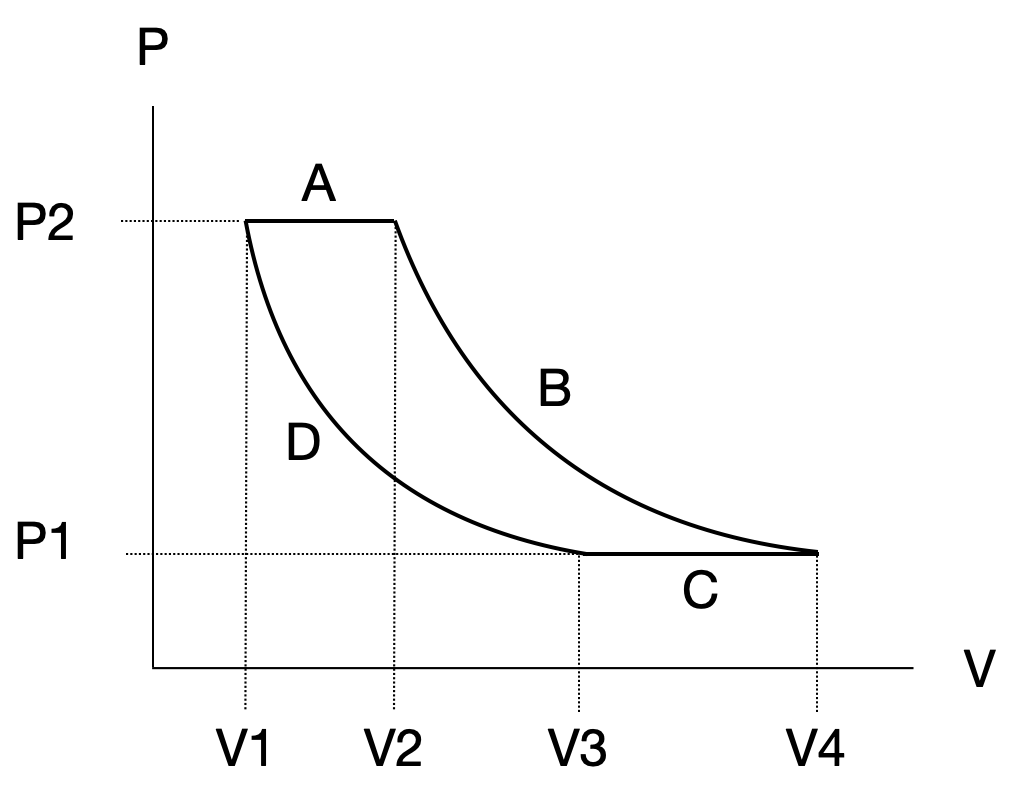
Find the efficiency of a cycle consisting of two isobaric (constant pressure) and two isothermal (constant temperature) lines if the pressure varies n-fold and the absolute temperature -fold within the cycle. The working substance is an ideal gas with the adiabatic exponent .
a) Assume there are two reservoirs at and . Assume that the isobaric processes occur while the system is in contact with the high temperature reservoir. What is the change in entropy of the environment?
b) If this cycle is taken reversibly, what would be the efficiency?
Solution:
To compute the efficiency, I will take the exhaustive approach. For each leg of this cycle, I will compute: work done by gas , change in internal energy , and heat transferred to gas , and precisely in this order.
Refer to the figure for labels. Path B has temperature , and path D has temperature . I will also use the following relations which come from the ideal gas law:
These will be used to write the volumes in terms of pressure and temperature.
Path A:
Path B:
. Next, using which implies , so that
Path C:
Path D:
And since , the ratio , so
Now we can put all the results together. The efficiency is defined by
The net work is the sum of all the work we found for each path:
Next, using and , i get
The heat inflow comes from Paths A and B. The sum of the heat absorbed along these paths is
Then all together,
Finally, we use the heat capacity at constant pressure
a)
We must treat the environment as two very large reservoirs which are kept at constant temperature. During A-B-C, the system is in contact with a reservoir at temperature , while during it is in contact with a reservoir at temperature . We can find the change in entropy using , since the reservoir is at constant temperature.
Path A:
The heat flows out of the reservoir, so
Path B:
Along this path, the heat again flows out of the reservoir, so
Path C:
Heat flows into the reservoir, so
Path D:
Heat flows into the reservoir here at the lower temperature , so
Summing up the change in entropy over all of these paths, we get
b)
In the previous problem, we found that , so this cycle is apparently reversible. In this process, the heat input comes from the reservoir, and is given by
The net work is , so that the efficiency is
Which is the Carnot efficiency!
Free Energy and Phases (Chapter 5)
Problem 1:
The ground state of a molecule has zero energy, and degeneracy equal to one. The first excited level has degeneracy four, and energy .
a) Calculate the difference in Helmholtz Free energy between the ground state and the first excited state at temperature . At what temperature does the free energy become zero?
b) Using the Boltzmann distribution, at what temperature is the excited state equally probable as the ground state. Compare to (a).
Solution:
a) The Helmholtz Free Energy is a state function, so we can compute it for each of these states.
Ground State:, and , so .
Excited State:, and , so
The free energy difference is just , which vanishes when
The partition function is
b) The probability of the ground state is the probability of observing energy zero, i.e.
The probability of observing an excited energy is , which is
These probabilities become equal when
which is the same answer as we got above.
Statistical Mechanics (Chapter 6)
Problem 1:
Consider a three state molecule with energies . Compute the Helmholtz free energy of a collection of molecules at temperature . Use this to find the entropy in two limits: and .
Solution:
The Helmholtz Free energy is related to the partition function by
So we just need to compute the partition function. For molecules, we can use , where is the partition function for a single molecule:
Therefore, the Free energy is
If you wish, this can also be written:
The entropy is obtained from the free energy from a partial derivative relation (see Lecture 13 )
Let us try to simplify this a little:
Now we can look at different limits:
Low Temperature:
To think about these limits, I will define . At low temperature, becomes very large. So we are taking the limit of the following:
replacing , we see that . This is precisely what we expect, since at zero temperature, the probably to be in the lowest energy state tends to one, and thus the entropy tends to zero.
High Temperature:
Now we consider large , which is the same as small . In this limit, we should expand the exponentials
This also makes perfect since. In the infinite temperature limit, the Boltzmann factor , which means every microstate becomes equally likely. The entropy then becomes the Boltzmann entropy, with the multiplicity being the number of possible microstates. For a collection of independent molecules, each with three energy levels, the multiplicity (total number of microstates) is , and so the entropy is , as found above.