Practice Exam Problems
Solutions to Practice Exam Problems
Heat, Work, and Ideal Gas (in HW 4)
One mole of an ideal diatomic gas at temperature
a) Plot this process on a PV diagram, assuming it is done slowly enough that the gas remains in equilibrium throughout. What is the functional form, i.e. how does P depend on V?
b) What is the final pressure?
c) Compute the heat, work and change in internal energy during this process? In writing down an equation for work, you must specify whether it's work done by the gas or on the gas.
d) Sketch a path from
Two-state system (in HW 4)
Consider a collection of
where
-
What is the multiplicity of microscopic configurations at a fixed energy
? -
Assume both
and are very large, and comparable in size. Use the Stirling approximation to write the entropy to leading order in these large variables. How many terms do you need to keep in the Stirling approximation to get a nontrivial result? -
Define the energy density
, and rewrite the entropy as a function of . At what value of is the entropy maximal? What is the value of the maximal entropy? -
From the entropy you found in Part 3, compute the temperature. Then invert this equation to find the density
as a function of temperature. Note that =
Entropy of 3-state spin (in HW 4)
Consider a collection of spins which can take three values:
The macroscopic variables for this system are the magnetization:
And the total energy
a) Take N = 2. Find all the possible macrostates, and enumerate their microstates.
b) Plot the entropy vs. U for this small system. Sketch what you think it will look like for larger systems (large
Challenge:
How many microstates exist for arbitrary
Entropy and Heat
An Einstein solid with
a) How is the energy related to the temperature? Compare it to the equipartition theorem, and see if the number of degrees of freedom makes sense.
b) Consider a constant volume process which changes the temperature from
Multiple Paths (Challenging)
Consider a 2D grid world, where you are allowed to only move up, down, left, and right on a 2D lattice of points.
Assume someone starts at point
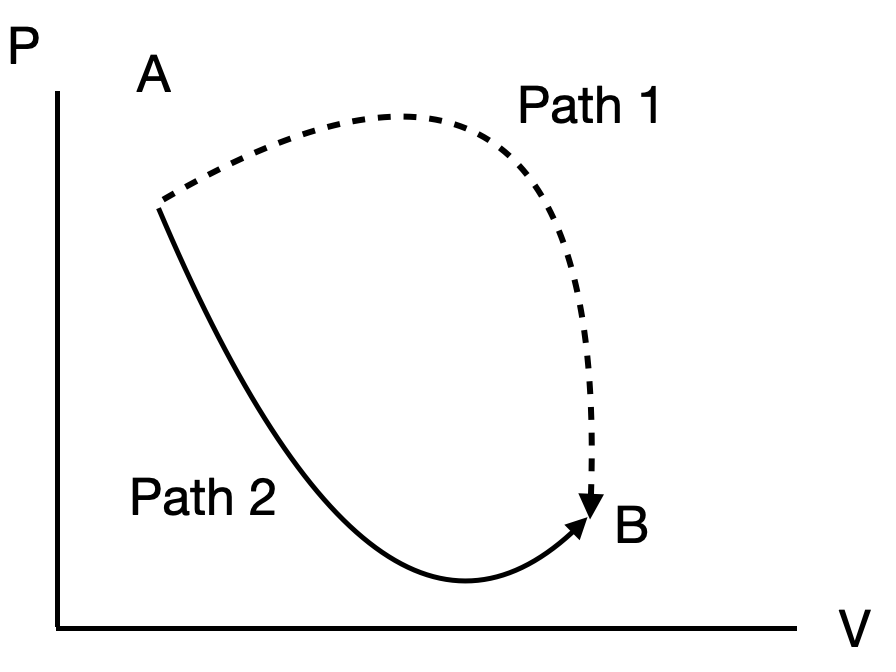
PV process and First Law
Below are two paths denoted 1 and 2, which take the system reversibly from
Adiabatic and Isothermal processes
Two identical gases start initially at the same pressure and volume, and end at the same pressure. Assume one process is isothermal, and the other is adiabatic. Sketch these processes on a P-V diagram under two conditions: 1) the gases are compressed, and 2) the gases are expanded. What is the difference in final volume between the two gases in each of these scenarios? (c.f. Problem 1.38)